A plant that travelled
A 2006 Cirad research abstract places vanilla within a history of movement from Mexico to the Indian Ocean and Pacific during the nineteenth century. It is not a plant that remained in an unchanged original landscape. Its establishment involved selection and local practices. A place name does not remove the need to distinguish the plant’s history from that of the knowledge developed around it.
Sources for this section: [1]
Tending the vine and flower
The Établissement Vanille de Tahiti describes propagation from cuttings, supports, shade and looping vines to keep future pods accessible. It also explains hand pollination, flower by flower. The work is more than waiting for fruit in a favourable climate: it organises growing conditions and requires attention to flowering. This description establishes neither a yield nor a timetable for an individual grower.

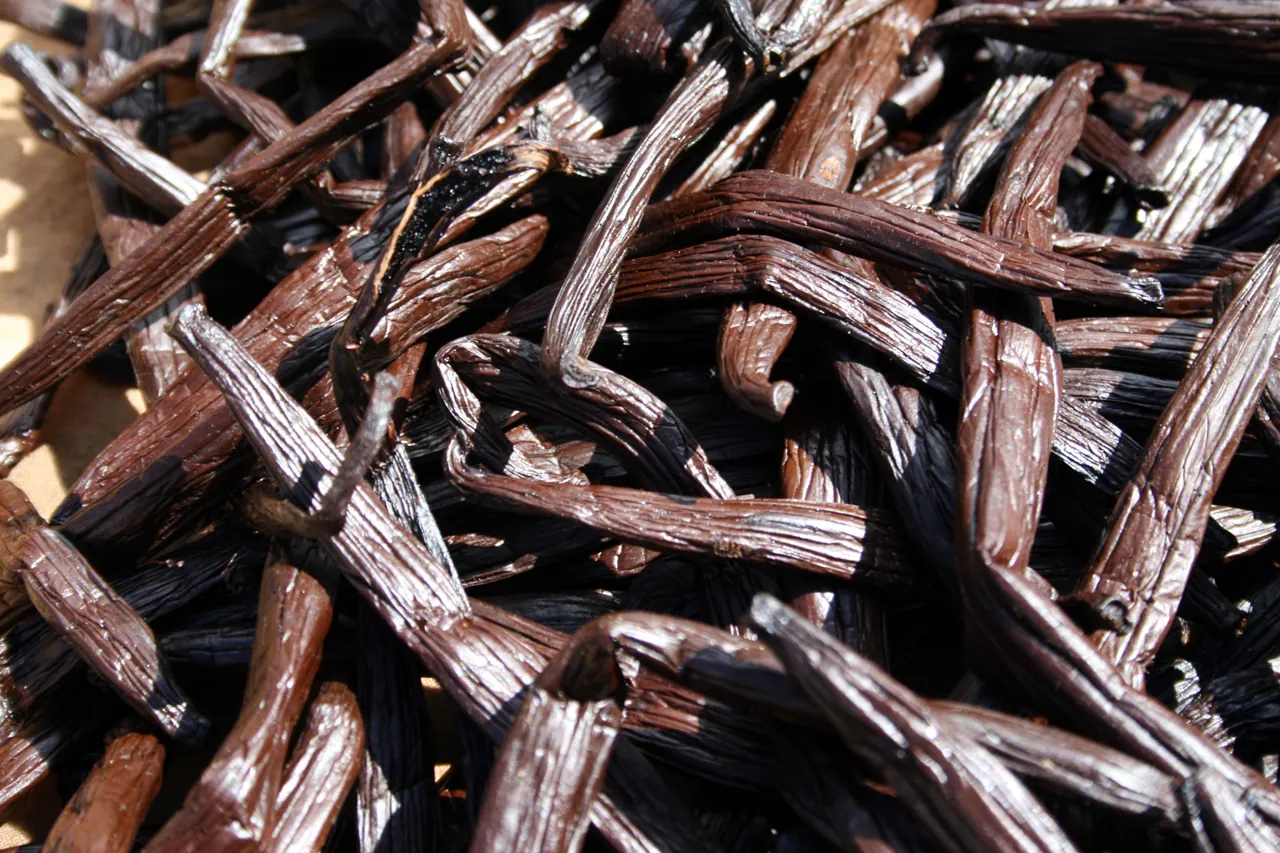
Remi Jouan · Source · CC BY-SA 3.0 · 2009-06 · Full photograph adapted for display.
Sources for this section: [2]
After harvesting, curing
In its 2026 technical document, the agriculture department describes alternating sun and shade, hand massaging, then resting away from heat. These operations accompany moisture loss and aromatic development. Massaging also helps distribute the pod’s contents and assess its drying condition. Curing emerges as a sequence of observations and actions, rather than simply waiting for a fixed amount of time to pass.
Sources for this section: [3]
Knowledge that is taught
An announcement of curing training in the Marquesas under the BPV 2024 programme distinguishes preparation from growing vines alone. That transition between kinds of work deserves to remain visible when looking at a pod. The attention given to learning also highlights transmitted skills: observing the material, intervening and following its transformation constitute work in their own right, alongside cultivation.
Sources for this section: [4]
The work behind the vanilla pod
After harvest, curing the pod takes time and a different set of skills. The work of growing the vine is only one part of preparing vanilla.
Sources and context
The sources are listed with their date or period.
- Diversité des vanilliers cultivés et apparentés ↗
M. F. Duval et collaborateurs · Cirad · Research conference abstract, July 2006
- La culture de la vanille de Tahiti ↗
Établissement Vanille de Tahiti · Technical overview, undated page
- Projet de cahier des charges « Vanille de Tahiti », p. 15 ↗
Direction de l’agriculture · document de demande · Document published March 2026, approval references unfilled; used for technique only
- Session de formation à la préparation de la vanille aux îles Marquises ↗
Établissement Vanille de Tahiti · Archived BPV 2024 training announcement
About this article
Article based on the cited sources, without a plantation visit. The 2026 document is a technical draft, not evidence that a geographical indication has been granted.
Published by Tahiti Vagabond.
Our method →