A history of creative adaptation
The Textile Research Centre places the arrival of cotton and missionary needlework in the early nineteenth century. QAGOMA also links tifaifai’s emergence to these exchanges. The textile developed in the islands did not remain a simple copy: combinations, colours and uses gave it a place of its own. Its history distinguishes an introduced technique from what local makers create with it.
Piecing fabric, applying shapes
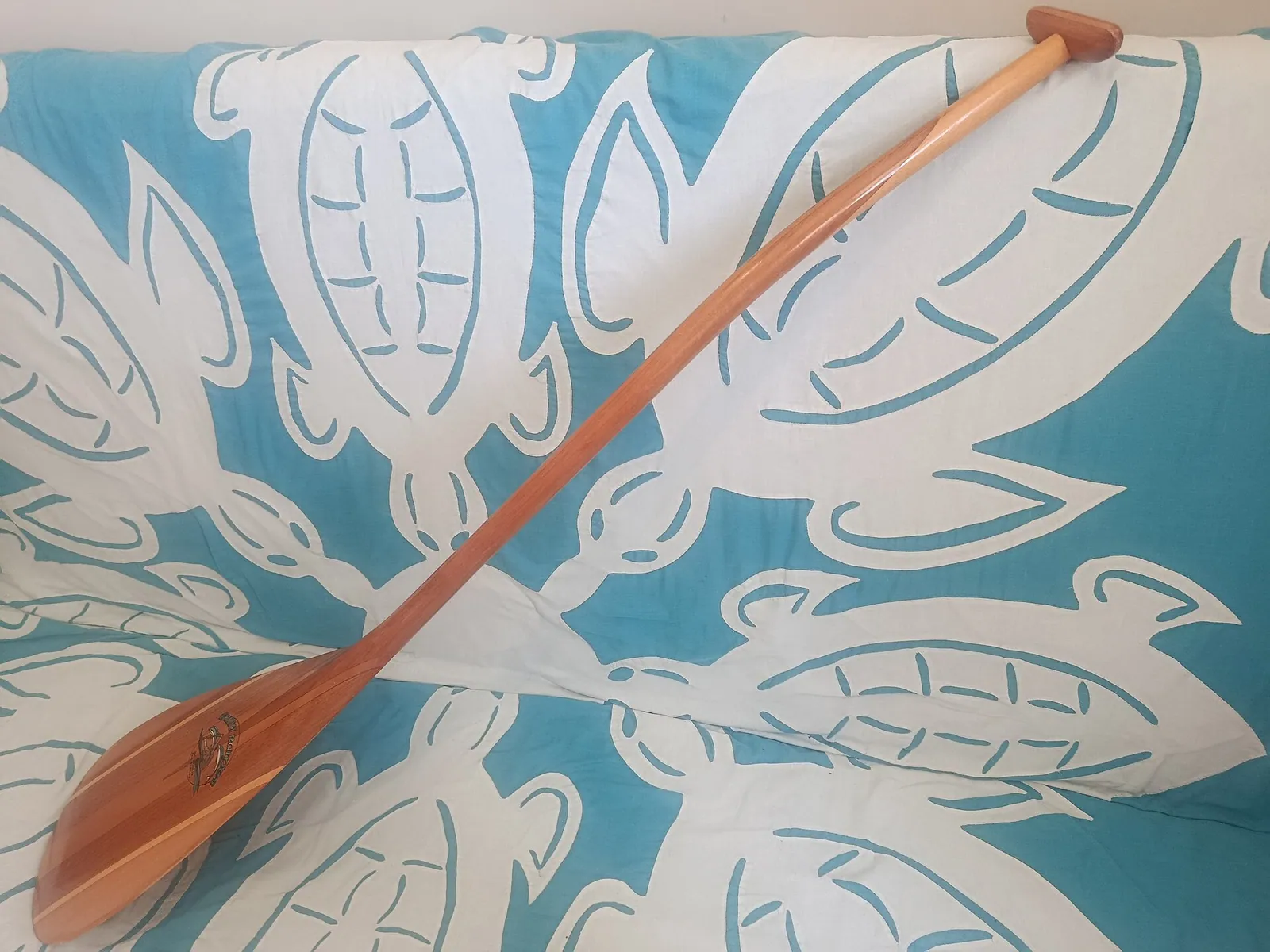
QAGOMA distinguishes pieced tifaifai pū from appliqué tifaifai pa’oti, in which cut shapes are sewn onto a backing. These approaches organise composition differently. In one, the image emerges from pieces meeting; in the other, from the relationship between a shape and its ground. Recognising the construction is a useful first step before assigning a meaning to every motif.
Sources for this section: [3]
Individual makers, not an anonymous style
Emma Tamarii’s collection entry describes learning from Tahitian women and adapting Marquesan carving designs in her 2000 work. Aline Amaru followed another approach: her 1991 La Famille Pomare combines a figurative narrative with needlework techniques. These named examples reveal individual decisions. They do not justify assigning the same intention to every tifaifai or treating makers as interchangeable.
What travels with the cloth
The Textile Research Centre notes tifaifai’s role in family gifts and significant occasions. What is passed on includes the object, but also learning, time and relationships. Without an account from a maker or family, a photograph cannot recover that whole history. It shows a textile; understanding its biography requires other evidence, rather than a symbolic explanation invented from its appearance.
Sources for this section: [1]
The cloth and the person who made it
When the maker of a tifaifai is known, keep their name alongside the work. It helps put the choice of motifs and composition in context.
Sources and context
The sources are listed with their date or period.
- Tifaifai ↗
Textile Research Centre, Leiden · Textile entry, updated 20 May 2017
- Emma Tamarii — Tifaifai (Marquesan style) ↗
Queensland Art Gallery | Gallery of Modern Art · Collection entry, artwork dated 2000
- Aline Amaru: La Famille Pomare ↗
Ruth McDougall et Maud Page · QAGOMA · June 2005 · artwork dated 1991
About this article
A synthesis of textile and collection records; no interview or observed workshop. The cited artworks are not reproduced. No universal symbolism, current sale or visit is asserted.
Published by Tahiti Vagabond.
Our method →