Beating rather than weaving
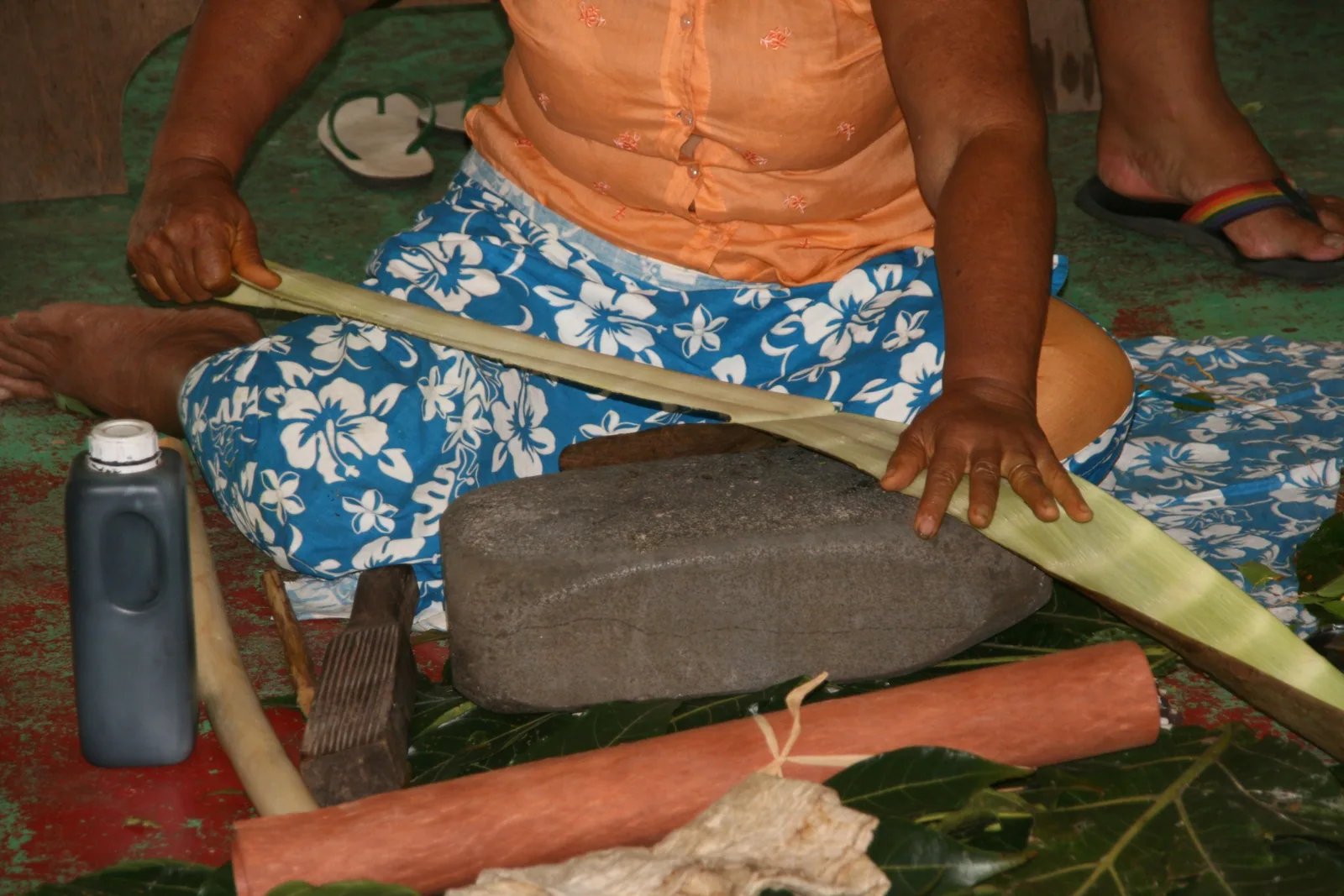
Tapa is cloth made by working the inner bark of certain plants. The Museum of Tahiti and the Islands’ archive describes a material formed by beating with suitable tools, rather than by interlacing threads. That difference changes what we notice: plant material, traces of work and the formation of a surface become ways of reading the object.
Sources for this section: [1]
Provenance is part of the object
The museum exhibition held from November 2014 to February 2015 brought together pieces from several Oceanian archipelagos. It also documented Marquesan samples made from aute, uru and ora. That past exhibition is not a current visitor offering. It does show why the origin of a piece matters before assigning it a technique or use supposedly shared across the Pacific.

Sources for this section: [1]
Uses that need context
The Ministry of Culture’s 2017 presentation of the book edited by Michel Charleux links barkcloth with exchange, ceremonies and stages of life. It also emphasises the diversity of designs and their affiliations. A drawn form cannot be given one universal interpretation from appearance alone. Context matters as much as decoration.
Sources for this section: [2]
A material that keeps changing
The same book also considers artists and designers who work with tapa. Transmission need not mean identical repetition: an inherited material can become part of new projects. Describing a particular creation would nevertheless require knowing its maker, origin and intentions. This article assigns no meaning to an individual work and reproduces no traditional design.
Sources for this section: [2]
Where does this cloth come from?
Start with where the tapa comes from. The plant used, the way the bark was worked and the purpose of the cloth help explain what you see.
Sources and context
The sources are listed with their date or period.
- Tapa d’Océanie d’hier et d’aujourd’hui ↗
Te Fare Iamanaha · Musée de Tahiti et des îles · Exhibition archive, 11 November 2014–21 February 2015
- Tapa. De l’écorce à l’étoffe ↗
Ministère de la Culture · ouvrage dirigé par Michel Charleux · Book presentation published on 10 October 2017
About this article
The museum dossier concerns an exhibition that ended in 2015. These sources do not establish the present-day routine of a Fatu Hiva workshop or allow us to speak for its makers.
Published by Tahiti Vagabond.
Our method →