Histories that meet
In a 2023 archive, the Maison de la Culture traces hīmene to the meeting of Polynesian singing and English Protestant hymns. The lyrics can tell a story or evoke an island or district.
Sources for this section: [1]
Three forms of tārava
The 2019 Heiva feature distinguishes tārava Tahiti, Raromata’i and Tuha’a pae. It presents them alongside rū’au and ’ūtē paripari. These categories help make sense of the Heiva archive without speaking for all Polynesian singing.
Sources for this section: [2]
Listening for complementary roles
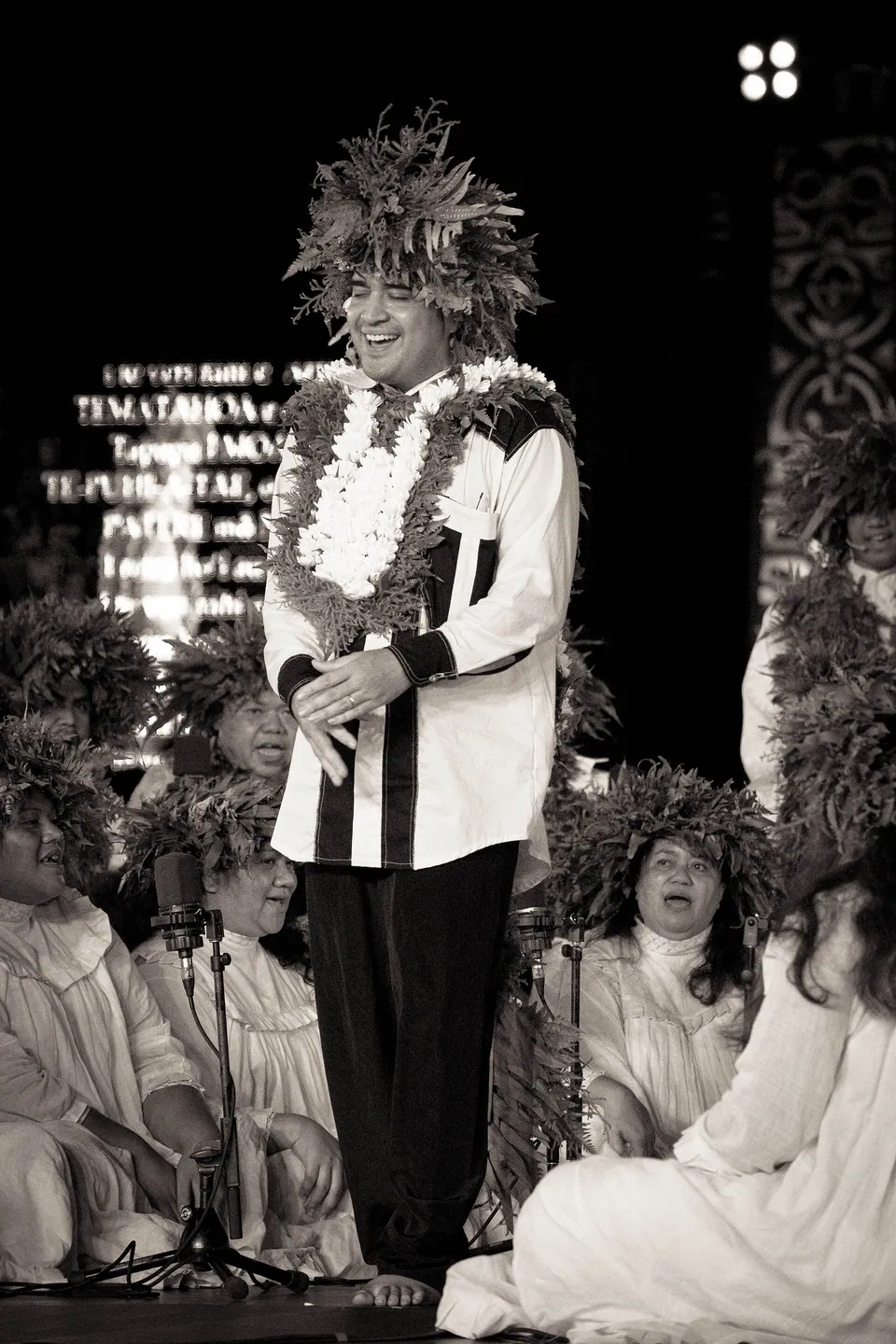
For the 2022 Ta’urua Hīmene, organisers highlighted perepere, marū teitei and tahape. The published presentation explained vocal roles rather than treating the choir as an undifferentiated sound. This teaching approach suggests a shift of attention: follow one line, notice an answer, then return to the whole. A written feature cannot replace a demonstration or a recording whose performers and context are identified.
Sources for this section: [3]
Transmission beyond prizes
The 2019 feature discusses learning in churches, while the 2022 gathering gave voices a dedicated setting outside the July competition. Singing emerges as a practice prepared and shared, rather than simply ranked. Across learning, rehearsal and performance, relationships between generations and between members of the group come into view. The archive offers a way to understand that collective work beyond the prize list.
Something to listen for
In a recording with named performers and context, try following one voice, then listen for the voices that answer it.
Sources and context
The sources are listed with their date or period.
- Le Ta’urua Hīmene met les chants traditionnels à l’honneur ↗
Lucie Rabréaud · Hiro’a n°190 · Maison de la Culture · Archive published 21 December 2023
- Heiva i Tahiti 2019 — Les chants ↗
Hiro’a n°142 · Maison de la Culture · July 2019 archive
- Le Ta’urua Hīmene va enchanter la pointe Vénus ↗
Pauline Stasi · Hiro’a n°180 · Maison de la Culture · 7 October 2022 · archived announcement
About this article
The sources date from 2019 to 2023 and explore the history of singing rather than the current programme. This article is based on those sources, without an on-site performance visit or interview.
Published by Tahiti Vagabond.
Our method →