Different craft for different uses
The Museum of Tahiti and the Islands distinguishes large double-hulled or outrigger canoes from smaller craft used for lagoon fishing and transport. Paddles and sails imply different uses. This variety encourages us to see a canoe as a response to an environment and an activity, rather than as one uniform Polynesian model.
Sources for this section: [1]
Techniques that change
For the Society Islands, the museum describes changes in sails, forms and construction as materials arrived from elsewhere. Lashings and caulking did not all disappear at once when nails, rope and sailcloth began circulating. Technical history can be read through these adaptations: neither a complete break nor an entirely unchanged inheritance.

Sources for this section: [1]
Racing is part of that history
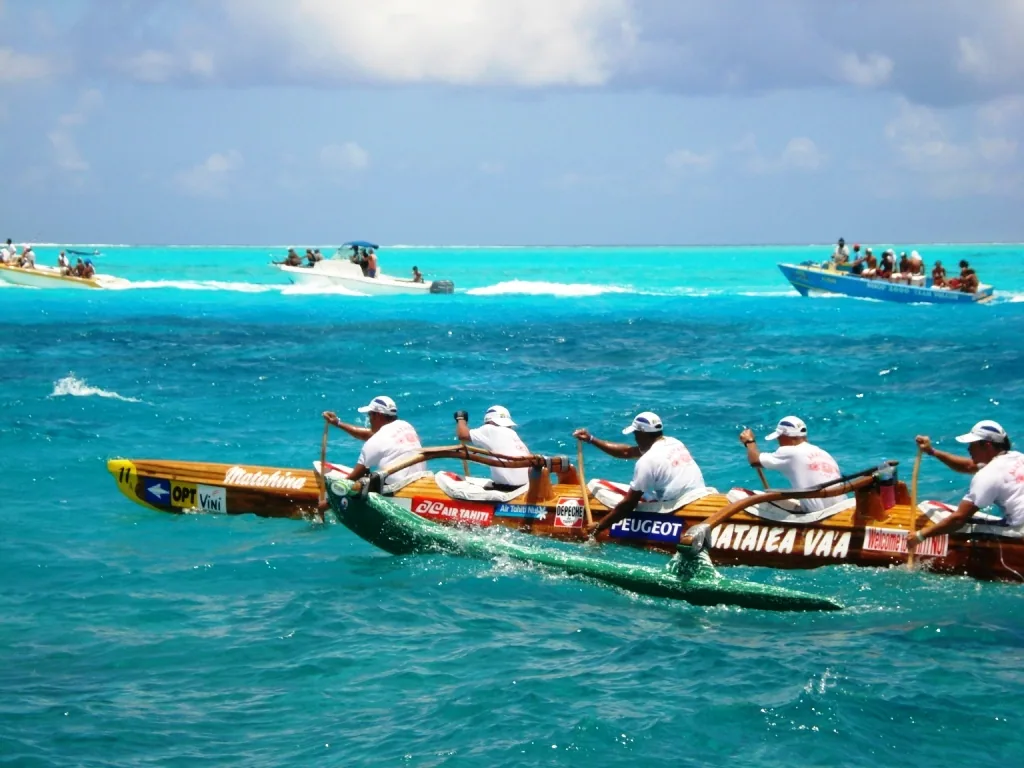
The museum’s account connects regulated races with celebrations organised under nineteenth-century colonial administration. Christian Laget’s lecture, hosted by the University of French Polynesia, also follows the development of va’a towards sport. Racing is therefore more than a present-day activity attached to an old object: it has a history in its own right.
Learning to act together
The DGEE’s school va’a resource places heritage within an educational project: finding one’s place in a group, gaining autonomy and acting responsibly. Its learning situations include coordinating paddlers and recognising reference points on the water. This educational perspective adds another dimension to the craft: it can support the learning of genuinely collective action.
Sources for this section: [3]
From museums to races and schools
A canoe in a museum tells you how it was built. A race shows how a crew works together, and a school session shows how paddling is taught.
Sources and context
The sources are listed with their date or period.
- Les pirogues ↗
Te Fare Iamanaha · Musée de Tahiti et des îles · Archive entry, 2020
- Une brève histoire du va’a, des origines au développement sportif d’aujourd’hui ↗
Université de la Polynésie française · Christian Laget · Recorded lecture, archive
- Le va’a à l’école ↗
DGEE · Bureau EPS · Educational resource
About this article
The historical reference points chiefly concern the Society Islands. No crew was interviewed for this article and no outing is presented as first-hand experience.
Published by Tahiti Vagabond.
Our method →